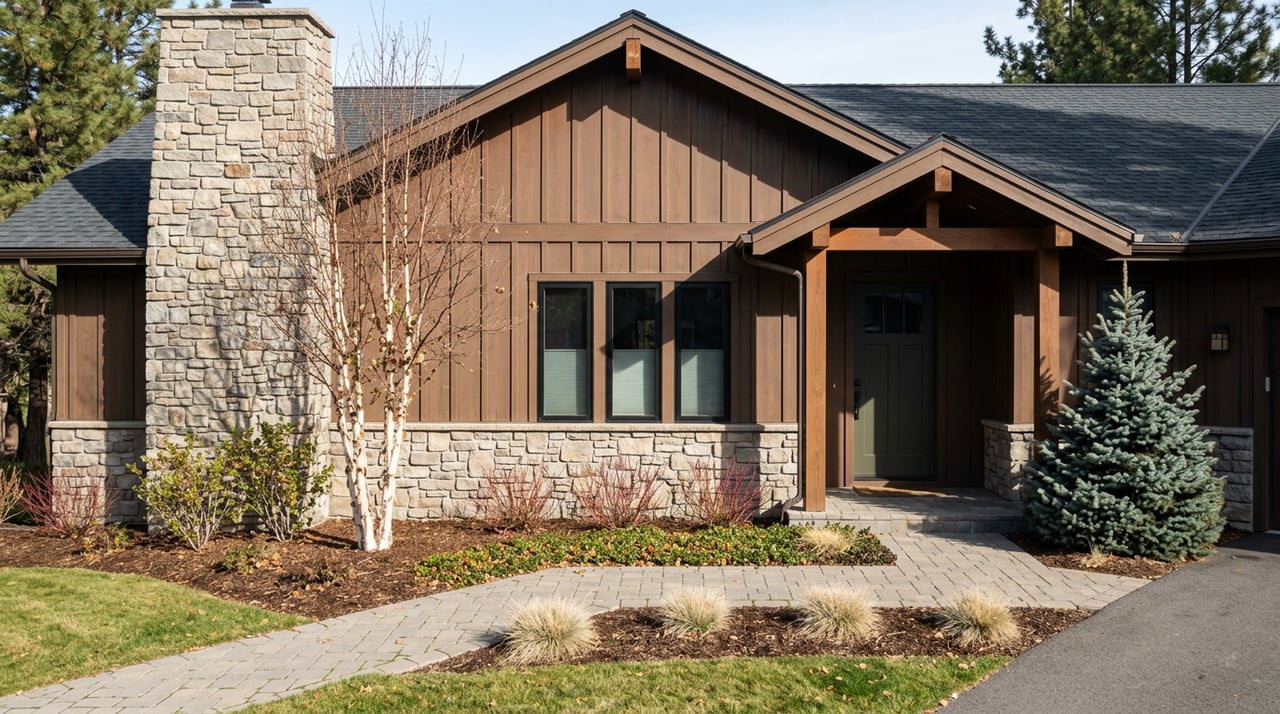
Walk down 8th Street and you'll pass a renovated craftsman on a lot twice the size of a two-bedroom condo at the base of the mountain, and the craftsman often costs less per square foot. That's the part of Old Town's math that doesn't match the story most buyers walk in with. The historic core is supposed to be the priciest ground in Steamboat Springs, the neighborhood where scarcity and charm command a premium over everything else in town. On a price-per-square-foot basis, it frequently doesn't.
Steamboat Magazine's 2026 market outlook put the citywide price per square foot for 2025 at roughly $963, a figure that eased about 4 percent from the year before. Old Town's own average commonly gets cited closer to the mid-$300s, though the range underneath that average is enormous: original-condition homes trade in the low hundreds per square foot, while new luxury condos push past $800. That spread is the first clue that something other than charm is setting the price here.
The lot, not the finish, sets the price
The reason Old Town's total dollar figures still run high while its per-square-foot average sits well below the citywide number is simple once you see it: buyers are paying for the lot and the location, not the finish level. Compact homes in the 1,200 to 1,800 square foot range, many of them century-old miners' cottages on streets like 7th and 8th, run $1.0 million to $1.5 million depending on condition. Mid-size renovated homes between 2,000 and 2,800 square feet run $1.4 million to $2.2 million. Condos start in the high $600,000s and move up sharply from there in newer buildings like Howelsen Place, The Olympian, The Victorian, and Alpenglow, which put lock-and-leave living directly inside the historic grid.
Put those numbers side by side with a citywide average PSF near $963 and the pattern holds: Old Town's entry price is a function of a shrinking supply of buildable lots on the original town grid, not a premium finish level. New construction here is almost nonexistent. Old Town gets occasional teardown-rebuild projects and infill, nothing close to greenfield development, because there isn't any greenfield left between the Yampa River and Strawberry Park. That scarcity holds up total dollar prices even as average per-square-foot numbers stay lower than what a base-area buyer is paying for a new-build condo with ski access.
What the Red Zone actually takes off the table
Here's the trade that explains the rest of it. When Steamboat Springs adopted its short-term rental overlay in June 2022, city council voted 6-0 to divide the city into three zones: green, where STR licenses have no cap, yellow, where licenses are capped by subzone and allocated through a lottery, and red, where new whole-home STR licenses are prohibited outright. Most of residential Old Town landed in the red zone. The commercial strip along Lincoln Avenue landed in green.
That zoning decision wasn't an accident of the map. During the public hearings that led up to the vote, residents in neighborhoods slated for red-zone status spoke up specifically to keep it that way. One Steamboat Springs local told council members plainly that she wanted her neighborhood to stay a community, not "a party zone of one long spring break all through the summer." Old Town's rental restriction is a policy choice locals fought to keep, and it has held through council's periodic revisits to the ordinance, including another round of changes in 2025.
What that means for a buyer in practice: a whole-home nightly rental license is off the table for most Old Town addresses. Hosted rentals, where the owner lives on site, and temporary rentals get treated differently, and a handful of parcels carry legal nonconforming status grandfathered in before 2022. None of that status transfers automatically at closing. A new owner has to apply fresh, and a license that looked airtight under the previous owner can evaporate the day the deed changes hands. Enforcement isn't gentle either. A spring 2026 review of Colorado mountain-town STR ordinances flagged Steamboat's posture as one of the more aggressive in the state, with fines that can run into the thousands per violation per day and operating bans stretching up to two years for repeat offenders.
Compare that to the mountain area, where STR-eligible condos near the base remain the most resilient corner of the entire Steamboat market. Same city, same overall price plateau, two completely different rulebooks depending on which side of a zoning line a listing falls on.
Why the restriction hasn't hurt Old Town's value
This is the part that should surprise anyone assuming a rental restriction automatically depresses price. It hasn't, at least not in Old Town. The buyer pool here was never competing on nightly yield in the first place. It's owner-occupants who want a real neighborhood over a resort building, and long-horizon investors who buy a renovated cottage, rent it long-term, and hold it as an appreciating asset rather than a cash-flow machine. Take the yield-chasing investor out of the bidding and what's left is a pool of buyers competing for something genuinely scarce: walkable, mixed-age, non-resort housing stock a few blocks from the Yampa River and Old Town Hot Springs.
| Home type | Typical size | Price band (2026) |
|---|---|---|
| Compact cottage | 1,200-1,800 sq ft | $1.0M-$1.5M |
| Mid-size renovated home | 2,000-2,800 sq ft | $1.4M-$2.2M |
| Condo (existing stock) | Varies | High $600,000s and up |
| New luxury condo | Varies | $800+/sq ft |
That's the mechanism behind Old Town's steady climb. The red zone doesn't just remove rental income. It removes an entire class of competing buyer, which leaves the field to people who value the thing the zoning was designed to protect.
The friction that shows up after you're under contract
Two more things catch buyers off guard once they're past the offer stage. Any home 50 years or older, and Old Town has plenty of them, can qualify as an Eligible Resource for the city's historic register, which triggers a mandatory review process for planning applications and building permits. Repainting the interior is fine. Replacing exterior siding, swapping windows, or adding a garage means a call to the city's Historic Preservation Planner before you pull a permit, and the city generally targets around 30 days for comments on many of those applications. Budget that time into a renovation schedule before you assume you can start work the week after closing.
The second surprise is what's behind the walls. Old Town's housing stock spans the 1900s through the 1970s, which means older electrical, older plumbing, and older furnaces show up more often than in newer subdivisions like Steamboat II or Strawberry Park. Lot lines are tighter too, and setbacks that would barely register on a larger Mountain Area lot can turn a simple garage addition into a variance request. This is where construction-level judgment earns its keep. Knowing which knob-and-tube wiring panel is a weekend fix and which one is a five-figure rebuild changes the entire renovation budget, and that number belongs in the offer before it becomes a surprise during inspection.
The trade in plain terms
Old Town charges a premium for the lot, not the square footage, and it charges that premium to a buyer pool that was never going to chase nightly rental income anyway. If short-term rental cash flow is the reason you're buying in Steamboat, the mountain area's green zone is the stronger play, full stop. If you want a neighborhood that still functions like one, with a mix of century-old cottages and modest infill condos within walking distance of Lincoln Avenue and the river, Old Town's restriction is the same thing that has kept it appreciating.
Does the historic review add real time to a renovation permit? Yes, if the home qualifies as an Eligible Resource. Exterior work, additions, and any change visible from the street should go through the city's Historic Preservation Planner before permitting starts, and the city's typical comment window runs around 30 days for many applications.
Can I ever get a short-term rental license in Old Town? Only through a hosted rental where the owner lives on site, a temporary rental, or a parcel that carries legal nonconforming status from before the 2022 ordinance. New whole-home licenses are not being issued in the red zone, and none of those statuses transfer automatically to a new owner at closing.
If you're weighing an Old Town cottage against a base-area condo and the numbers aren't lining up the way the listing photos suggest, that's usually the zoning line talking. Will Kennish has spent two decades reading Steamboat's market block by block and knows which side of that line a specific address falls on before you write an offer. Make the Move. Live the Dream.